
Boeing Reclaims the Order Crown: Inside the 2025 Airbus–Boeing Scorecard
Boeing outsold Airbus in 2025 for the first time in seven years — 1,173 net orders to 889 — the headline the American manufacturer waited a long crisis to write. It sits on top of a more uncomfortable truth: neither planemaker can yet build at the rate its order book now demands, and the binding constraint is no longer demand but the supply chain feeding the line. This briefing takes the 2025 scorecard apart — orders, deliveries, the record backlogs, and the Spirit AeroSystems break-up now reshaping who actually builds the ramp — and asks what it means for airlines, lessors and investors. Less panic, more facts.
The Order Win That Ended Seven Years
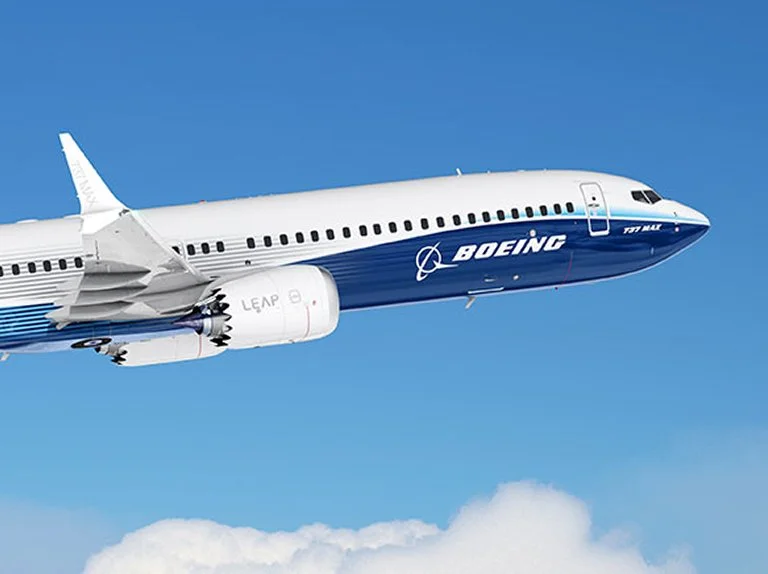
Image: Boeing 737 MAX — the 737-10 anchored Alaska’s record 2025 order | Boeing
In 2025 Boeing booked 1,173 net commercial orders against Airbus’s 889 — the American manufacturer’s first annual order victory since 2018, and the clearest evidence yet that its recovery has substance behind it. The number matters symbolically after a run of years defined by the 737 MAX grounding, the Alaska Airlines door-plug incident, a bruising machinists’ strike and an FAA-imposed production cap. Boeing’s book was led by 591 net commitments for the 737, 381 for the 787, 180 for the 777 family and 15 for the 767 — a recovery weighted, unusually, toward the widebody top of the range.
The single most important driver was the 787 Dreamliner, in one of its strongest order years on record, as long-haul demand recovered and carriers moved to secure scarce widebody slots into the next decade. Delta Air Lines’ commitment for at least thirty 787s was emblematic — its first direct order for the type, with deliveries not beginning until the early 2030s. Narrowbody demand did the rest: Alaska Airlines placed the largest order in its history, 105 737-10s plus five 787s with rights to a further 35 MAX 10s, extending its delivery stream to 2035. Layered on top was an unmistakable political dimension, with a series of 2025 trade visits generating headline commitments for Boeing jets — a tailwind Airbus’s own chief executive publicly acknowledged. But an order is a promise, not a payment, and the promise is only the first half of the story.
Image: 2025 net orders and deliveries, Boeing vs Airbus | Boston Warwick Analysis
Why the Delivery Crown Still Matters More
Airlines pay the majority of an aircraft’s price on delivery, not at order. That single fact is why Airbus’s seventh consecutive delivery lead — 793 aircraft to Boeing’s 600 — matters more to near-term cash generation than Boeing’s order headline. Airbus’s 2025 commercial revenue rose to €52.6 billion on the back of higher volumes, and it converted backlog into hardware at a steadier, more predictable pace than its rival managed at any point since 2018.
The gap is narrowing quickly, though. Boeing’s 600 deliveries were its best since 2018 and a sharp recovery from the 348 it managed in 2024, a year hollowed out by the machinists’ strike. The contrast in throughput is captured by book-to-bill: Boeing added close to two orders to its backlog for every aircraft delivered, against roughly 1.1 at Airbus — a firm refilling its order book fast, but from a lower delivery base. If Boeing can hold its production discipline and lift the MAX above the FAA’s rate cap, the delivery race becomes genuinely competitive again in 2026 rather than the rout it was two years ago.
The Real Prize: Getting Back to Volume
The order tables make headlines, but the metric that will define this decade for both manufacturers is one neither has yet mastered: sustained, high-rate delivery. Boeing’s 600 aircraft in 2025 was a genuine recovery, yet it remains roughly a quarter below the 806 it delivered in 2018, the last full year before the MAX grounding. Airbus’s 793 was a strong result but still short of the record 863 it handed over in 2019. Six years on from their respective peaks, neither has returned to it. That gap — between what the order book demands and what the factories can produce — is the central industrial problem in commercial aerospace, and it represents several billion dollars a year in deferred revenue to each firm.
Restoring volume is hard for reasons that compound. Every rate increase has to be matched simultaneously across the entire supplier pyramid; a single constrained input — an engine, a fuselage section, a forging, a fastener — caps the whole line regardless of how much capacity sits elsewhere. Skills and experience were lost through the pandemic and are slow to rebuild, and both manufacturers are now deliberately trading speed for stability, prioritising quality after a decade in which haste proved expensive. The consequence reaches well beyond the two OEMs: while output stays below demand, airlines cannot renew fleets fast enough, older and less efficient aircraft remain in service longer, lease rates and used-aircraft values stay elevated, and the industry’s emissions trajectory slips. The ramp is not a Boeing-versus-Airbus story. It is a whole-industry constraint, and it is decided in the supply chain.
Image: Deliveries 2018–2025 against pre-crisis peaks — the volume neither OEM has recovered | Boston Warwick Analysis
The Supplier Question: Who Builds the Ramp

Image: Airbus A330neo (F-WTTN) — Airbus insourced A350 and A220 structures in the Spirit split | Airbus
The most consequential structural event of 2025 was not an order but the break-up of Spirit AeroSystems. On 8 December, Boeing and Airbus completed the carve-up of their largest shared structures supplier, ending the twenty-year outsourcing experiment that began when Boeing spun off its Wichita division in 2005. Boeing reabsorbed Spirit’s Boeing-facing commercial and aftermarket operations — 737 fuselages, major structures for the 767, 777 and 787, and its largest spare-parts business — bringing roughly 15,000 employees back in-house and standing up a new Spirit Defense unit. Airbus, in a separate transaction of around $439 million that the US Federal Trade Commission required in order to preserve competition, took the sites dedicated to its own programmes: A350 fuselage sections at Kinston, North Carolina and Saint-Nazaire, A321 and A220 work at Casablanca, and A220 wing and mid-fuselage production at Belfast, adding some 4,000 staff. The remainder of the historic Belfast site passes to Boeing as Short Brothers.
The driver was quality, not cost. Spirit sat at the centre of Boeing’s worst recent failures, from the MAX programme to the January 2024 door-plug blow-out traced to supplier workmanship, and reintegration is a tacit admission that the arms-length model had pushed control too far from the manufacturer. But bringing the work in-house also transfers a distressed balance sheet: Spirit carried a backlog of roughly $51 billion against persistent operating losses, and both OEMs now absorb the cost and capital of stabilising and scaling those sites. Insourcing buys oversight; it does not, by itself, make the underlying industrial problem go away.
Risk, Reward and the Squeeze on Tier 1
Spirit’s distress is the clearest symptom of a wider strain running through the supplier base, and it traces back to how risk is shared. The 787 pioneered an aggressive risk-and-revenue-sharing model, pushing not just fabrication but design and financing risk out to partners; when the programme ran years late, several of those partners absorbed losses they had limited means to recover. Across the structures tier more broadly, suppliers typically sign long fixed-price agreements calibrated to high build rates and benign inflation. Through the 2020s they got neither — rates stayed capped, input and labour costs rose sharply, and quality-driven rework added expense — leaving Tier 1 firms exposed to the downside of a downturn without a share in the upside of the eventual recovery. Spirit is simply the largest name to have been caught in that trap.
This matters for the ramp because production is gated by its weakest link: an OEM can only build as fast as its slowest critical supplier can deliver. The Pratt & Whitney geared-turbofan shortage now capping Airbus’s A320neo line is the same problem viewed from the powerplant end, where risk-and-revenue-sharing partners on the major engine programmes are themselves straining to scale. For investors and private equity, this is precisely where opportunity and risk concentrate — in recapitalising or acquiring squeezed Tier 2 and Tier 3 suppliers, in financing spare-engine pools against the GTF shortfall, and in backing the MRO capacity that a larger, harder-worked in-service fleet will demand. The next phase of value creation in aerospace may be found less in the OEMs at the top of the pyramid than in the stressed layers beneath them.
The Backlog: Eleven Years, Two Shapes

Image: Airbus A350-1000 — the widebody backlog reached a record 1,124 aircraft | Airbus
Airbus closed 2025 with 8,754 aircraft on firm order — the highest year-end figure in its history — of which a record 1,124 are widebodies. At current delivery rates that represents roughly eleven years of production already spoken for. Boeing’s backlog of 6,713 offers a comparable eleven years of visibility, but with a materially different shape: it leans harder on widebodies, with 1,076 787s, 676 777/777X and 94 767s standing behind a 737 MAX book of 4,867. Airbus’s backlog, by contrast, is overwhelmingly single-aisle — some 7,157 A320neo-family aircraft and 467 A220s alongside 830 A350s and 294 A330s.
For anyone valuing these franchises, the backlog is the real story. It is a multi-year revenue floor that insulates both manufacturers from any single year’s order swing — which is precisely why the 2025 order result, striking as it is, changes less about the competitive balance than the headlines imply. The scarce resource is not demand; it is a delivery slot before 2032. That scarcity, more than any annual scorecard, is now the single most important variable in fleet planning.
Image: Year-end 2025 order backlog by segment, narrowbody vs widebody | Boston Warwick Analysis
The Widebody Battleground
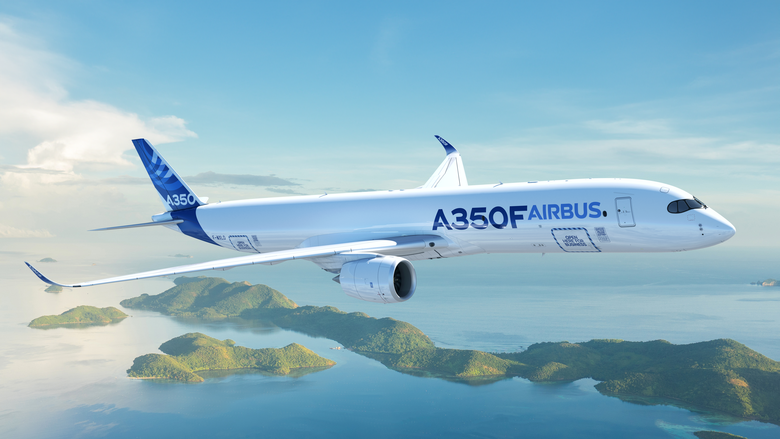
Image: Airbus A350F — a new-generation freighter backlog in the making | Airbus
Widebodies are a minority of units but a disproportionate share of value and profit, and 2025 confirmed this as the segment where the contest is fiercest. Boeing’s 787 is the clear commercial winner of the year, but Airbus’s response is broad: the A350 took 193 orders, the A330neo added 102, and both the A350-1000 and A330neo welcomed new operators during the year. A widebody line long overshadowed by narrowbody volume is regaining momentum at exactly the point when carriers are re-engaging with long-haul fleet renewal.
The freighter market is a quieter but strategically important front. Airbus’s A350F continued to build its order book through 2025, positioning the type against Boeing’s ageing 777F and the delayed 777-8F. As emissions rules tighten on older freighters through the late 2020s, that new-generation cargo backlog is an asset whose value the market has arguably not yet fully priced — and, for lessors and freight operators, a firm A350F position is becoming one of the more defensible assets in the widebody universe.
Narrowbody and the Production Ceiling
The A320neo family remains the centre of gravity in single-aisle. It out-sold the 737 MAX again in 2025, and the A321neo alone has now passed 7,500 lifetime orders — a franchise the MAX has no direct answer to at the top of the segment. In October 2025 the A320 family formally overtook the 737 as the most-delivered jetliner in history. This is the structural advantage that survives any single year’s order table.
The binding constraint on both firms, again, is not orders but the ability to build. Airbus has been explicit that Pratt & Whitney geared-turbofan shortages are throttling its A320neo ramp: it cut its 2025 delivery target from 820 to 790 (landing at 793), pushed its rate-75 goal for the A320 to the end of 2027, and now targets 13 A220s a month only by 2028. Boeing’s ceiling is regulatory and self-imposed — the FAA’s cap of 38 MAX per month, and its own decision to prioritise quality over speed. Whichever manufacturer clears its constraint first will win the delivery race of the late 2020s, and with it the cash.
The Certification Overhang

Image: Boeing 777-9 — certification timing remains a key 2026 watch item | Boeing
Boeing’s order book carries a notable dependency on aircraft it cannot yet deliver. The 737 MAX 10 — the variant underpinning Alaska’s record order and a large slice of the 737 backlog — remains uncertified, held up by an anti-icing fix that has run for years. The 777-9 is similarly delayed. Both are strong sellers; both convert to revenue only once regulators sign off. For airlines holding MAX 10 and 777X positions, certification slippage is a live fleet-planning risk that belongs in every 2026 capacity model — a delayed type is a hole in a schedule that has to be filled with older, thirstier metal or with lift bought in at short notice.
What This Means for the Industry
For airlines and fleet planners, the practical message is that slots — not list prices — are the scarce resource. Widebody replacement decisions cannot wait when useful delivery positions already sit in the 2030s, and dual-sourcing across both manufacturers is increasingly prudent for delivery risk as much as for negotiating leverage. Certification slippage on the MAX 10 and 777X should be modelled explicitly rather than assumed away. For lessors and investors, new-technology widebody residuals on the 787 and A350 are well supported by thin supply and deep order books; Airbus offers more predictable near-term delivery cash flows, while Boeing offers a recovery re-rating with execution risk still attached.
For the MRO, supply chain and private-equity community, the story runs deeper than the OEMs. Rising Boeing volumes will lift aftermarket demand across engines, components and ground support; the geared-turbofan shortage is both the sector’s defining bottleneck and its clearest opportunity; and the reintegration of Spirit signals that the pendulum has swung back from outsourcing toward control, with more consolidation of stressed Tier 1 and Tier 2 suppliers likely to follow. The overarching conclusion is that 2025 restored a genuine two-horse race after years in which one competitor ran effectively unopposed — but it did not overturn Airbus’s structural advantages in narrowbody scale, backlog depth and delivery consistency. The winners over the next five years will be those who plan around delivery reality, and around the health of the supply chain that delivers it, rather than around order-book theatre. We will monitor the 2026 production ramp, the engine supply position, the Spirit integration and the MAX 10 and 777X certification milestones, and update as the picture develops.
Stay Ahead with Boston Warwick Weekly Aviation Insights
Receive our in-depth executive briefing every week — routes, fleet moves, airport developments, finance and the strategic implications, before your competitors.
Subscribe Now →SOURCES
- Airbus, “Airbus reports 793 commercial aircraft deliveries in 2025” (13 January 2026) and Full-Year 2025 results (19 February 2026)
- Boeing, 2025 orders and deliveries summary (13 January 2026)
- Forecast International / Flight Plan, December & Full-Year 2025 orders and deliveries (15 January 2026); “End of an Era: Boeing Reintegrates Spirit AeroSystems” (8 December 2025)
- CNBC, “Boeing outsold Airbus last year for first time since 2018” (13 January 2026)
- Alaska Air Group / Boeing, largest airplane order in the airline’s history — 105 737-10s and five 787s (7 January 2026)
- Bloomberg and Aerospace Manufacturing & Design, Boeing–Airbus completion of the Spirit AeroSystems split (8–9 December 2025)
- Spirit AeroSystems Holdings, SEC Form 8-K disclosures on the Boeing merger and Airbus disposition (2025)
This post reflects our independent analysis and does not constitute investment advice. Boston Warwick Ltd provides strategic advisory services to participants across the aviation value chain.