
American Reaches 100 Latin America Destinations | Heathrow Third-Runway Step & easyJet in Play | Aviation Insights 15–21 June 2026
Boston Warwick drives transformative change for airlines, airports, and aviation stakeholders. Its expert team, with decades of experience, delivers high-impact projects in flight operations, fleet valuations, and M&A, empowering clients with strategic insights.
This week, covering Monday 15 to Sunday 21 June 2026, the US system entered its summer peak under deliberate, FAA-imposed capacity discipline as the controller shortfall persisted. Network strategy made the running elsewhere: American crossed a 100-destination milestone in Latin America, European consolidation gathered pace as Air France-KLM pre-positioned a €1 billion war chest and easyJet drew a takeover approach, and the UK took its next formal step toward a third runway at Heathrow. Fleet and efficiency moves from Cathay and Delta rounded out a week framed throughout by elevated jet fuel prices and Middle East airspace risk.
Airlines
American Airlines Reaches 100 Destinations in Mexico, the Caribbean and Latin America

Image: American Airlines Embraer E175, the type assigned to the new Miami–Maracaibo route | American Airlines
American confirmed it will become the first US carrier to serve 100 destinations across Mexico, the Caribbean and Latin America — the network it groups internally as MCLA — anchored on its Miami hub. The 99th and 100th points are Maracaibo and Cap-Haïtien. Maracaibo (MAR) begins as daily Embraer 175 service from Miami on 14 July, the only nonstop link between the United States and Venezuela's second city, adding to American's twice-daily Miami–Caracas flights and making it the first US carrier to resume US–Venezuela service. Both routes carry a premium cabin and AT&T-sponsored high-speed Wi-Fi.
Cap-Haïtien (CAP) follows on 1 November as daily Boeing 737 service — the first announced return of US-carrier flying to Haiti, and pointedly to the northern city rather than Port-au-Prince, where the FAA's restriction on US flights remains in force, extended through 3 September after gunfire incidents near the capital. American frames Haiti as the largest Caribbean market currently unserved by a US carrier, supported by South Florida's Haitian-American community. The carrier notes its winter MCLA network will run roughly 50% larger than its nearest US competitor's, built on more than 410 peak daily departures from Miami, with a new Flagship lounge and a reimagined Concourse D planned as part of its centennial-year investment in the hub.
Condor Expands Management Board with New CFO and Newly Created CCO Role
Condor expanded its management board to five members, naming Dag Jessel as Chief Financial Officer with effect from 6 July and creating a Chief Commercial Officer role filled by Dr. Pierre Dominique Prümm from 1 August. Jessel succeeds Björn Walther, CFO since June 2022, who is leaving at his own request after steering the carrier's financial stabilisation. Jessel arrives with extensive Lufthansa Group experience spanning finance, HR and M&A, including a posting as Director Finance & HR for North Asia.
Prümm joins from Fraport, where he sat on the executive board for aviation and infrastructure and oversaw Frankfurt's Terminal 3 programme — a notable cross-hire as Condor sharpens its commercial function. He takes responsibility for network and partnerships, revenue management, cargo, sales and e-commerce. The reshuffle reflects Condor's transformation from a leisure charter operator into a scheduled network carrier building its own city network, a shift that carries rising commercial complexity and followed a loss of roughly €110 million last year tied to fleet modernisation and network build-out. The moves position Condor more deliberately as an independent challenger to Lufthansa in the German market.
Cathay Group Adds A330P2F Freighter at Air Hong Kong to Lift Regional Capacity

Image: Air Hong Kong Airbus A330 converted freighter | Cathay Cargo
Cathay Group said Air Hong Kong — its all-cargo subsidiary and the city's first dedicated freighter airline — has signed a long-term lease for one Airbus A330P2F converted freighter, sourced from Air Transport Services Group through its Cargo Aircraft Management arm and due to enter the fleet in the fourth quarter of 2026. Air Hong Kong currently operates 14 A330 freighters flying express services for DHL Express; the new aircraft will primarily serve Mainland China and other regional destinations on behalf of Cathay Cargo.
The lease follows last month's firm order for two additional A350F freighters. A passenger-to-freighter conversion is cheaper and quicker to deploy than a new-build, and Cathay positions it as a complement to the incoming A350Fs that buys near-term regional agility while the larger aircraft arrive. The addition leans on the capacity unlocked by Hong Kong International's Three-Runway System and reinforces the airport's standing as the world's busiest cargo hub. It sits within a Cathay Group fleet-and-product investment programme exceeding HK$100 billion and more than 100 aircraft on order, alongside the group's existing 20 Boeing 747 freighters and bellyhold capacity across a passenger network serving over 100 destinations.
Mergers, Acquisitions & Finance
Air France-KLM Signs €1 Billion Facility as Consolidation War Chest

Image: Air France-KLM Airbus A350 | Air France-KLM
Air France-KLM signed a new €1 billion multi-purpose credit facility with a syndicate of 12 international banks, drawable and repayable at the group's discretion, with an initial maturity of June 2028 and a one-year extension option to June 2029. The group was explicit that the facility serves two purposes: refinancing existing instruments and funding M&A that may arise from the second half of 2026. It does not change gross debt or the net-debt-to-EBITDA ratio, which stood at 1.5x at the end of March, within the group's 1.5–2.0x target.
The M&A reference is concrete. Air France-KLM intends to raise its stake in SAS from 19.9% to 60.5% by buying out Castlelake and Lind Invest in a transaction targeted for completion in the second half of the year, and has tabled a non-binding offer for TAP Air Portugal's privatisation in competition with Lufthansa, attracted by Lisbon's geographic leverage into the Brazil and wider South America market. CEO Ben Smith has separately signalled he would "perhaps" consider easyJet if approached. Read against that backdrop, the facility is best understood as pre-positioned firepower as European consolidation accelerates rather than a defensive liquidity move.
easyJet in Play as Castlelake's £3 Billion Approach Runs to a 26 June Deadline
easyJet is in play. US investment firm Castlelake — roughly $36 billion in assets and majority-owned by Brookfield — disclosed in late May that it is weighing a possible offer pitched at no less than 403.23 pence per share, valuing the carrier at a minimum of about £3.06 billion, an approach that lifted the shares around 13%. Under the UK Takeover Code, Castlelake must announce a firm intention to bid or walk away by 5:00 pm on 26 June, just after this briefing publishes. easyJet's board has called the approach "highly opportunistic" while acknowledging its duty to consider any formal proposal.
What makes easyJet a target is its derating: shares are down roughly 20% year-to-date and about 40% over twelve months on Iran-conflict demand and fuel fears, with relegation from the FTSE 100 to the FTSE 250 in March and a first-half loss. The complications are real — EU ownership rules sit awkwardly with a non-European buyer, founder Sir Stelios Haji-Ioannou holds a 15% stake plus a revenue royalty, and Barclays has argued the parts are worth well above the indicated price. Castlelake knows European airline workouts from the inside, having sold its SAS stake to Air France-KLM, whose Ben Smith said he would "absolutely" take a call but is not involved. The episode is a useful signpost for how far the consolidation wave may run.
Airport Developments
UK Publishes Draft Heathrow Expansion Policy Statement; Phased Runway Door Left Open
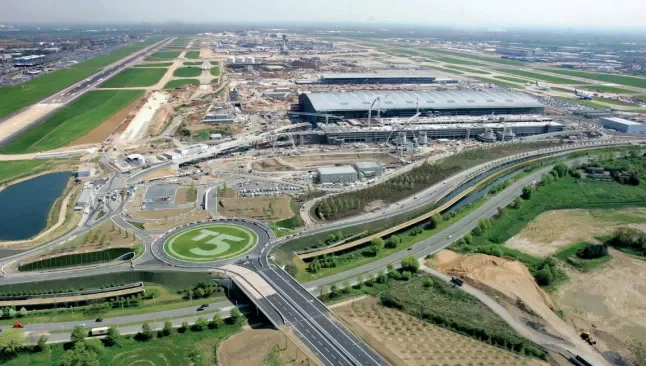
Image: London Heathrow airfield and terminals | Heathrow
The UK government published a draft Heathrow Expansion National Policy Statement and opened a ten-week consultation running to 1 September — the planning framework against which any third-runway application will be judged, with a final planning decision targeted for 2029. Transport Secretary Heidi Alexander told the Commons the scheme is designated "critical national growth infrastructure," allowing it to bypass certain local planning hurdles. Heathrow Airport Limited's £49 billion proposal, submitted last August, sets out a 3,500-metre northwest runway (around £21 billion), a new "T5X" terminal complex and satellites (about £12 billion), and roughly £15 billion modernising existing terminals including the eventual closure of Terminal 3, lifting capacity some 50% to about 150 million passengers and 756,000 flights, with realignment of the M25 beneath the new runway.
The notable shift is that ministers explicitly opened the door to phased delivery, keeping alive the rival Heathrow West scheme backed by Surinder Arora's group — a shorter circa-2,800-metre runway first, deferring the costly M25 rerouting — which IAG and Virgin Atlantic have endorsed as the only route to first flights before the mid-2030s. The draft still names HAL as statutory undertaker and applies four tests covering growth, climate compatibility, air quality and noise. The real financing gate is the CAA's regulatory model and early-cost-recovery decisions, due this summer, which will determine whether private capital flows. Heathrow handled a record 84 million passengers last year as the world's busiest two-runway airport, underlining the capacity case.
US Hubs Enter the Summer Peak Under FAA-Imposed Capacity Caps
The US system opened its summer peak with capacity deliberately throttled at key hubs. Chicago O'Hare is operating under federally imposed limits of about 2,708 movements per day from mid-May to late October, trimming roughly 300 flights on peak days; Newark remains capped at around 68–72 arrivals and departures per hour through October amid runway work and staffing constraints; and Las Vegas saw multi-hour ground-delay programmes this week. The metering is intentional — the FAA reduces flow to match what controllers can safely handle, converting potential congestion into managed delay.
The cause is structural. The FAA sits roughly 3,500 certified controllers below target and in May reset its full-staffing benchmark to about 12,563, down from 14,633, with close to 11,000 certified controllers carrying the load on heavy overtime. Around 19 of the 30 largest facilities run below 85% of their staffing targets, and those facilities account for roughly 40% of delays across the national airspace system. Even strong 2026 hiring will not certify quickly, given training timelines of two years or more. For airlines and airports the operational implication is unchanged: build schedule buffer and contingency into the peak, particularly across the congested Northeast and at World Cup host-city hubs.
Industry Innovations & Services
Delta to Fit VCT Finlets Across 240 Boeing 737NGs for Drag and Fuel Savings
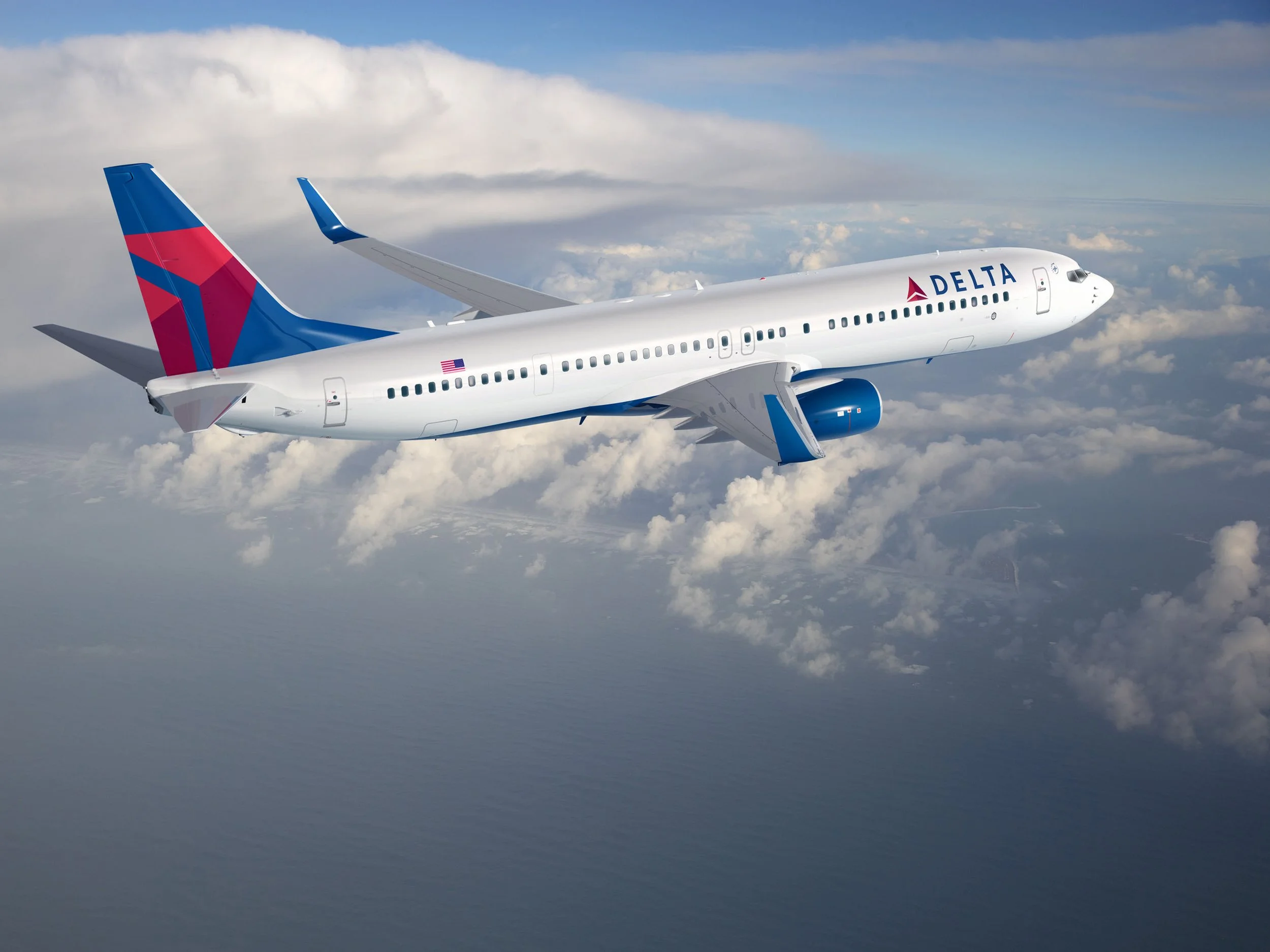
Image: Delta Air Lines Boeing 737-900ER | Delta Air Lines
Vortex Control Technologies said Delta Air Lines will install its finlet modification package across the carrier's Boeing 737-800 and 737-900ER fleet — about 240 aircraft once complete. Finlets are small aerodynamic devices added around the aft fuselage that reshape airflow, reduce flow separation and lower drag, translating into reduced fuel burn and emissions. Delta's decision followed an in-service evaluation drawing on flight-test data, operational trends and computational-fluid-dynamics review of aerodynamic performance on its 737NG aircraft.
For Delta, where jet fuel accounts for roughly 90% of its carbon footprint, a retrofit that extracts efficiency from existing airframes is attractive against the alternative of waiting on constrained new-build deliveries — a recurring calculation as the global fleet ages past an average of 15 years. The programme is a pragmatic, low-disruption efficiency play, with a marginally smoother ride as a passenger-facing side benefit, and a meaningful scale win for VCT. Expect more aerodynamic and retrofit initiatives of this kind as carriers chase unit-cost gains while fuel stays elevated.
Key Watch Items
ATC Staffing and Summer-Peak Resilience
Controller staffing remains the binding constraint on US capacity into July. Watch certification throughput against attrition, facility-level staffing at the busiest 30, and whether flow programmes spread beyond the Northeast as thunderstorm season and event traffic stack up. Schedule discipline at capped hubs will be the difference between managed delay and cascading disruption.
Jet Fuel Prices and Middle East Airspace
Fuel is the swing factor for the year. At its Rio AGM in early June, IATA cut its 2026 industry net-profit forecast to roughly $23 billion — close to half its earlier figure — on a near-70% jump in jet fuel prices tied to Middle East conflict, even as it lifted projected revenue about 9.4%. Watch Gulf airspace availability, rerouting and GNSS interference, and how quickly carriers re-price to defend thin margins.
World Cup Operational Load on US Airspace
With the FIFA World Cup running 11 June to 19 July across 11 US host cities, match-day temporary flight restrictions — a three-nautical-mile, 3,000-foot radius over stadiums, backed by the FAA's DETER drone-enforcement effort — and passenger surges at host-city airports add a live operational layer through the peak. Watch on-time performance at affected hubs on match days.
Stay Ahead with Boston Warwick Weekly Aviation Insights
Receive our in-depth executive briefing every Sunday — covering routes, fleet moves, airport developments, finance, and strategic implications before your competitors.
Subscribe Now →